
*******
According to one of Spinoza’s early biographers, Johannes Colerus, Spinoza enjoyed drawing and sketched portraits of people in ink and charcoal (Nadler, 1999, p. 288). Spinoza also chose, at several points, to live in rooms rented out by master painters. He first lodged with the painter Daniel Tydeman (ibid., p. 203), and later rented a room from the painter Hendrik van der Spyck, who focused primarily on interior decorations, but also completed works of portraiture (ibid., 1999, p. 288).
In this post, I will focus on what Spinoza’s own visual imagery and artworks say about him, focusing primarily on the imagery on his signet ring and secondarily on his self-portrait, which Colerus describes but which has been lost to time.
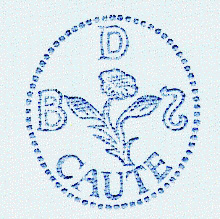
Spinoza, like many of his day, used a signet ring to mark the wax used to seal the letters he mailed. The impression in the wax served as a kind of secondary, personal signature. So, for example, Spinoza’s letter to the famous philosopher Leibniz included an imprint of his ring (Bagley, 1999, p. 241).
Spinoza’s signet ring included, centrally, an image of a rose, surrounded by the letters B.D.S., for Benedictus de Spinoza (Eckstein, 1943, p. 154). Below the rose is the Latin word “Caute,” an adverb meaning “cautiously.” When printed alone like this, the word “caute” is often treated like a command – like “be cautious!”
If you look at the rose on his signet ring carefully, you will see that it has long thorns (Eckstein, 1943, p. 154). This is deliberate. The name “Spinoza” derives from the Portuguese word “espinhosa” which means “from a thorny place” (Nadler, 1999, p. 27), and the name is also related to the Spanish word for thorn, “espina.” Pairing the thorny rose with his initials, it is clear that Spinoza intended a kind-of visual pun on his name.
What does the “caute” below the rose mean? Different theorists have interpreted it different ways. Some think Spinoza was indicating that he is cautious and meticulous in his rigorous, philosophical reasoning, while others think that Spinoza included “caute” to indicate that he was cautious with his true philosophical views and deliberately chose not to share them with everyone (Bagley, 1999, p. 241).
Indeed, Spinoza was cautious when it came to sharing his true philosophical views with others. He chose not to publish his Short Treatise, fearing the hatred and attacks of theologians of his day (Nadler, 1999, p. 191), he chose to indefinitely delay the publication of his most famous work, Ethics, for similar reasons (ibid., pp. 218 & 335), and when he arranged for his Theological-Political Treatise to be published, the first edition did not list him as an author and provided a fake publisher and place of publication (ibid., p. 269). Likewise, Spinoza was also very careful about which individual people he permitted to learn of his true beliefs (cf. Bagley, 1999, pp. 241-242 & 244-245).
No doubt, Spinoza was himself cautious. But this does not seem to be all that Spinoza was trying to indicate by including the word “caute” on his signet ring.
To see why, again consider the thorns on the rose in the middle of the signet ring, below which the word “caute” appears. The visual pun on Spinoza’s name, discussed above, appears to equate Spinoza with thorns! As some scholars have indicated, it is as if Spinoza is saying: “Beware of Spinoza; he is thorny” (Eckstein, 1943, p. 154). Note, again, that the word “caute” can be treated like a command. By including “caute” in an imprint in wax on a letter mailed to someone, Spinoza seems to command the receiver of the mail to be careful! Be cautious! Of what should the receiver be cautious? The receiver should be cautious when dealing with Spinoza, or when dealing with Spinoza’s ideas (cf. Eckstein, 1943, p. 154).
No doubt, Spinoza showed a substantial degree of caution with respect to how he shared his views and the people with whom he shared them. But Spinoza also showed courage by choosing to share his view with others in the first place (Eckstein, 1943, p. 154). After being excommunicated from his Jewish community in 1656 for discussing heretical beliefs and opinions (Nadler, 1999, pp. 120 & 130), Spinoza nonetheless chose to publish his Theological-Political Treatise, even when he was aware of how likely it was to provoke attacks. Spinoza knew, after all, that his acquaintance Adrian Koerbagh had been sentenced to prison for publishing blasphemous beliefs – beliefs sometimes similar to Spinoza’s own (ibid., pp. 2265-269).
In essence, Spinoza knew that what he was doing was dangerous. And arguably, with his signet ring’s impressions, he was warning those whom he mailed to be careful when dealing with him and his ideas, lest they face difficulties, themselves.
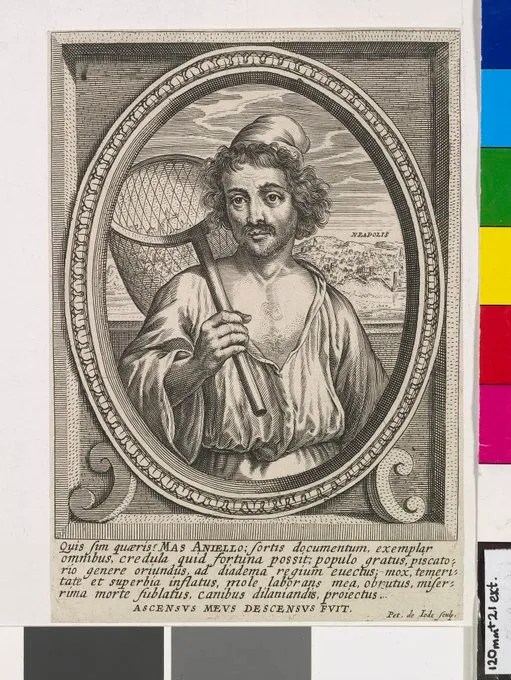
There is reason to think that Spinoza viewed himself as a revolutionary involved in dangerous enterprises. According to Spinoza’s early biographer, Colerus, Spinoza – who liked to draw – once completed a self-portrait and based his self-portrait on images of the Italian revolutionary Tommaso Aniello, also known as “Masaniello” (Stewart, 2006, p. 97; Nadler, 1999, p. 204).
Masaniello was a fisherman who led a revolt, in 1647, against the rule of Spain before being murdered and torn apart. Portraits of Masaniello, like that pictured above, often portray him as a fisherman with a fishing net on his shoulder. According to Colerus, Spinoza’s self-portrait made Spinoza look like Masaniello and transformed Spinoza into a fisherman with a net (Stewart, 2006, p. 97; Nadler, 1999, p. 204).
It appears that Spinoza saw himself as somehow similar to Masaniello. Did he conceive of himself as a “hero of the people” (Stewart, 2006, chapter 6)? Did he view himself as a revolutionary, seeking liberation? Did he view himself as doomed to potentially meeting a tragic fate, like that of Masaniello?
Regardless, if we think that Spinoza viewed himself as somehow similar to Masaniello, we might change how we understand the thorny rose and “caute” on his signet ring (cf. Eckstein, 1943, p. 154). Perhaps Spinoza meant to indicate that he, himself, was cautious, both in his rigorous use of reason and with how and when he shared his views with others. But arguably Spinoza also meant to tell those he mailed to be careful! Spinoza knew he was doing something dangerous and revolutionary. Spinoza was thorny, be careful of him, and be careful of the views he expresses, or you might get hurt.
Indeed, in 1666, one of Spinoza’s critics, Abraham Peyrera, published a book in which he, too, indirectly implied that Spinoza is thorny and dangerous to others. Spinoza had been excommunicated from his Jewish community around the same time that another man, Juan de Prado, had also been excommunicated, and Spinoza and Prado were connected in the public consciousness (Nadler, 1999, p. 146). Meanwhile, much like Spinoza’s name is closely related to the Spanish word for “thorn,” Prado’s name is the same as the Spanish word for “meadow.” To indirectly indicate that Spinoza was thorny and dangerous, Peyrera punned on the names “Spinoza” and “Prado,” writing (in English translation):
“What is this world except barren ground, a field full of thistles and thorns [espinos – Spinoza], a green meadow [prado – Prado] full of venomous serpents” (as quoted by Nadler, 1999, p. 146).
Peyrera implied that Spinoza is dangerous, like thorns and serpents, and should be viewed as such. Is it so far a stretch to think that Spinoza, with the thorny rose and “caute” on his signet ring, was implying much the same, although obviously in a positive way rather than negative!
Spinoza liked to draw, and so it is quite possible that he, himself, drew the image of a rose that was subsequently included on his signet ring. It is also possible that Spinoza, himself, also crafted the actual signet ring. Spinoza was a lens grinder and also made telescopes and microscopes (Nadler, 1999, p. 182), and it is fairly likely that he would have the tools necessary to craft a signet ring. But even if Spinoza neither drew the rose nor crafted the ring, his interest in art and drawing makes it likely that he chose his imagery – his visual signature – quite deliberately.
The rose itself was often treated as a symbol of secrecy, with the Latin phrase “sub rosa,” under the rose, connoting confidentiality. It is striking that Spinoza, on his ring, included the word “caute” – caution – right below the image of a rose, literally sub rosa. It was as if he was saying: “Keep what is included in this letter secret. It could be thorny and dangerous to you.”
When Spinoza suffered from respiratory problems, which eventually led to his death, his doctor prescribed to him a “concoction of red roses” – crushed rosebuds and sugar (Nadler, 1999, p. 234). Having used a rose as part of his visual signature, and as a symbol for secrecy and of dangerous thorniness, I wonder if Spinoza might have thought it was ironic that he was now being prescribed roses for his health.
REFERENCES
Bagley, P.J. (1999). Spinoza, Philosophic Communication, and the Practice of Esotericism. In P.J. Bagley (Ed.), Piety, Peace, and the Freedom to Philosophize (pp. 233-269). Kluwer Academic Publishers.
Eckstein, W. (1943). The religious element in Spinoza’s Philosophy. The Journal of Religion, 23(3), 153-163.
Nadler, S. (1999). Spinoza: A Life. Cambridge University Press.
Stewart, M. (2006). The Courtier and the Heretic: Leibniz, Spinoza, and the Fate of God in the Modern World. W.W. Norton.

