
*******
What do Dr. Dre and Ice Cube have to say about making music with the help of Artificial Intelligence (AI)?
On November 6th, the first episode of a new podcast aired – the Listen and Laugh Podcast. It’s hosted by rapper Ice Cube and comedian Mike Epps. When you tune in, Cube will make you listen and Epps will make you laugh. New episodes will drop every Friday at 6 P.M Eastern on YouTube and on other major platforms.
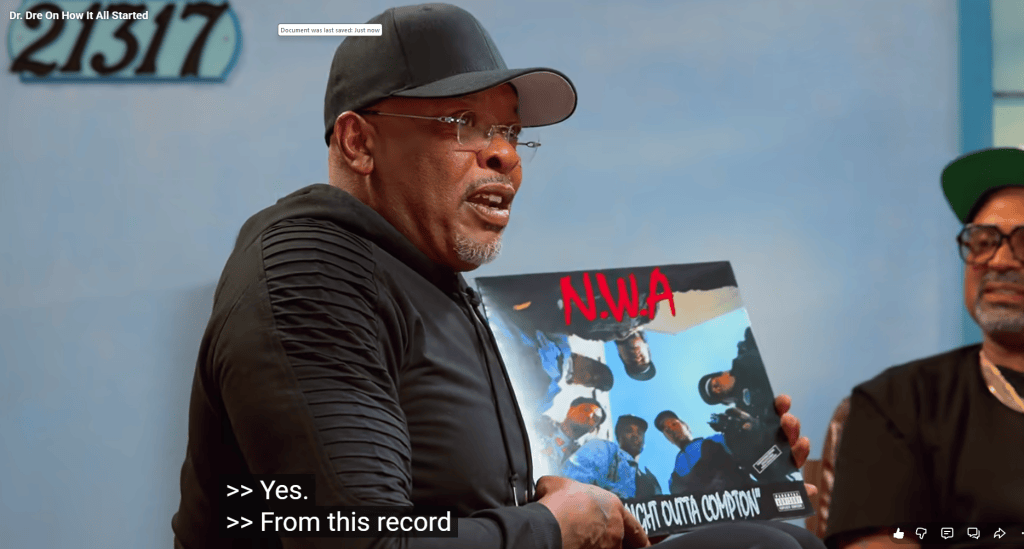
The guest on the first episode is the legendary rapper/producer Dr. Dre. He and Ice Cube were members of the hip-hop group N.W.A. when it released its album Straight Outta Compton in 1989. Cube and Dre have stayed in touch since then. Dr. Dre has talked about how much music he’s sent Ice Cube over the year – music that the public has never heard.
On Listen and Laugh, Cube and Dre talked about AI. Is there anything wrong with using AI to help create music?’
“I’m extremely excited about AI,” Dre said. “I love it. I love the potential of it. I love the idea of where it could possibly go . . . It’s just a whole new level of creativity.”
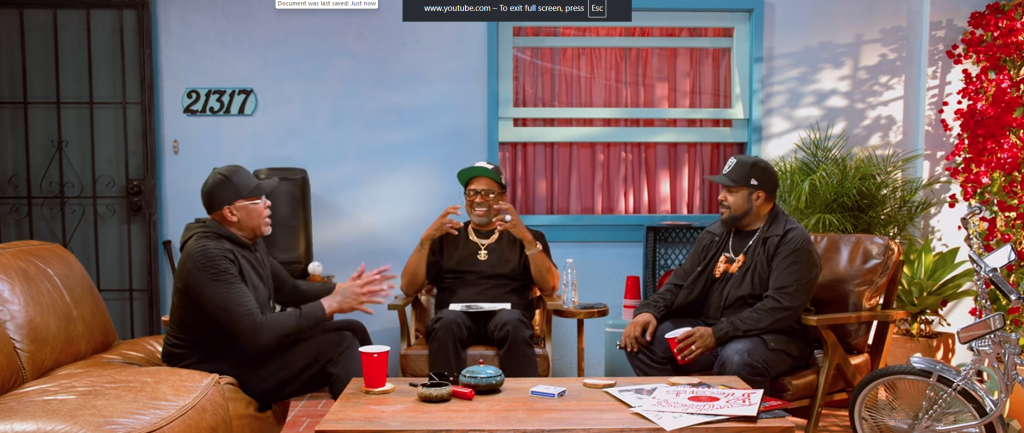
Dre sat with Cube and Epps on a podcast set made to look like an outdoor porch, with couches and casual chairs. Cube asked Dre how he would feel if a studio used AI to mix records that sounded a lot like Dr. Dre’s own work.
Dre responded: “As a creative force and as an innovator, I could not be mad at that. I would respect that.” Dre said he wouldn’t mind if up-and-coming artists used AI to make their records sound more like him. But why wouldn’t he mind?
Dre explained that using an AI like this is a lot like the process of sampling.
Many Hip Hop artists sample other artists’ work. They take samples of other artists’ work – sections or elements of their music – and then manipulate them, chop them, loop them, and layer them with other elements to create something new (cf. Costa, n.d.)
Compare artists who sample other artists’ work to artists who use an AI to include elements of other artists’ work. How different, really, is sampling from using an AI?
Ice Cube asked Dre if he would be upset if an artist used an AI to make work that sounded like Dre. Dre responded that asking this is similar to asking artists if they’re mad that their work was sampled. “Would you be mad at someone sampling your records?” Dre asked Cube. If the answer is “no,” then you shouldn’t be mad if someone used an AI to include elements of your work, either.
The songs that Dre and Cube made, as part of N.W.A., frequently sampled other artists’ work. Straight Outta Compton includes elements from the music of The Winstons, Funkadelic, Wilson Pickett, and many others (Who Sampled, n.d.). So when Dre talked to Cube about sampling, he was talking about their own history of working together. If what they did, sampling music, was cool, then isn’t AI cool too? And what Dre and Cube did was cool.
After all, no one is cooler than Ice Cube.
Ice Cube pushed back at Dr. Dre. He asked Dre what he would think if a new artist, using an AI, remade one of Dre’s songs and made it more popular, bigger, and better than the original.
“I would love that,” Dre responded.
“You would love it?” Cube pushed back. “Even if it was a computer that made it better?”
“I would love that,” Dre said. “Because that is a part of creativity and innovation.”
Dre insisted, again, that using an AI like this is – in all important respects – like sampling. But Ice Cube wasn’t convinced. He correctly noted that the artists who is doing sampling is still human – a skilled human – who is sampling the work of another skilled human. “You’re still going from human to human to make a creation that’s something fresh and new from something old.”
There are two points here. One is the value of humanity. The other is the value of skill and creativity. The artists who sampled and made great music – like Dre and Cube – were showing their own human skill and creativity. But what happens if someone who has no skill or creativity could use an AI to create a great, popular new track? Cube said, “It just bothers me that an artist or somebody can work for years and years to become great and then somebody can not do shit but roll over” and still create a great record.
But Dr. Dre insisted that human artists, who use AI to create records, often do still show great skill and creativity. It takes creativity and skill to use an AI to make something great. It’s just a different sort of skill and creativity. But what’s wrong with that?
Still, Dre acknowledged that eventually humans might not need skill or creativity anymore. “It could go to a place with this AI shit where we’re not necessary or needed.” At that point, would there be a problem with using AI?
Ice Cube’s final verdict on the use of AI in music went like this: “I don’t think nothing [is] wrong with it. But I don’t have to like it.”
This is just one of many conversations that Dr. Dre had with Ice Cube and Mike Epps as a guest on the Listen and Laugh podcast. And what was written, above, is not the entire conversation. It leaves a lot out. Listen to the podcast for more.
Future episodes of the podcast will include an array of different guests including Cedric the Entertainer, Dana White, Jack Harlow, Regina King, Dana White, and many others. And you will also hear conversations between Mike Epps and Ice Cube, too.
Epps and Cube co-starred together in the 2000 film Next Friday, and then later acted together in All About the Benjamins (2002), Friday After Next (2002), and The Janky Promoters (2009). They have also toured with each other and have just known each other forever.
At this point, Epps and Cube are almost family. In the Friday franchise, they played Craig and Day-Day, who were cousins. In an interview with Kurt “Big Boy” Alexander, Cube said that for Next Friday, he wanted Epps because of how much he seemed like Cube’s cousin: “I just needed him to seem like, hey, yo, these two dudes are cousins. This is my crazy cousin” (BigBoyTV, 2026). And Cube says that in the Listen and Laugh Podcast, “people will see that me and Mike relationship is very similar to Craig and Day-Day but in real life.”
Check out the podcast for more great conversations and laughter.
When can you watch the next episode?
Next Friday.
REFERENCES
BigBoyTV. (2026, May 21). Ice Cube & Mike Epps explain cast changes of Chris Tucker and Katt Williams and preview Last Friday [Video]. YouTube. https://www.youtube.com/watch?v=_SzhIkQeBpU
Costa, L. (n.d.). Music sampling explained: Creative techniques and copyright laws every producer should know. The Los Angeles Film School. https://www.lafilm.edu/blog/music-sampling-explained/
Who Sampled. (n.d). Songs sampled in Straight Outta Compton. https://www.whosampled.com/N.W.A/Straight-Outta-Compton/samples/
*******
I agree with Nafy AI Team’s comment, below, that when using AI, the source relationship is sometimes harder to see than it is for traditional sampling. But I would ush back on the idea that there is a strong difference between AI and sampling when it comes to “consent.” For example, I very much doubt that when Ice Cube and Dr. Dre began sampling other artists they always had consent from those artists. I strongly imagine they didn’t. If I’m right, then the lack of consent is much the same for AI as it was for their early sampling. Regardless, Nafy AI Team’s comment is interesting!
The comparison with sampling is useful, but Cube’s pushback identifies the key difference: sampling has established practices for attribution, licensing, and the visible craft of transformation. AI music can also require real judgment in prompting, arrangement, editing, and performance, yet the source relationship is often harder to see. Consent and provenance may matter more than whether the tool itself counts as creative.


Leave a Reply