
*******
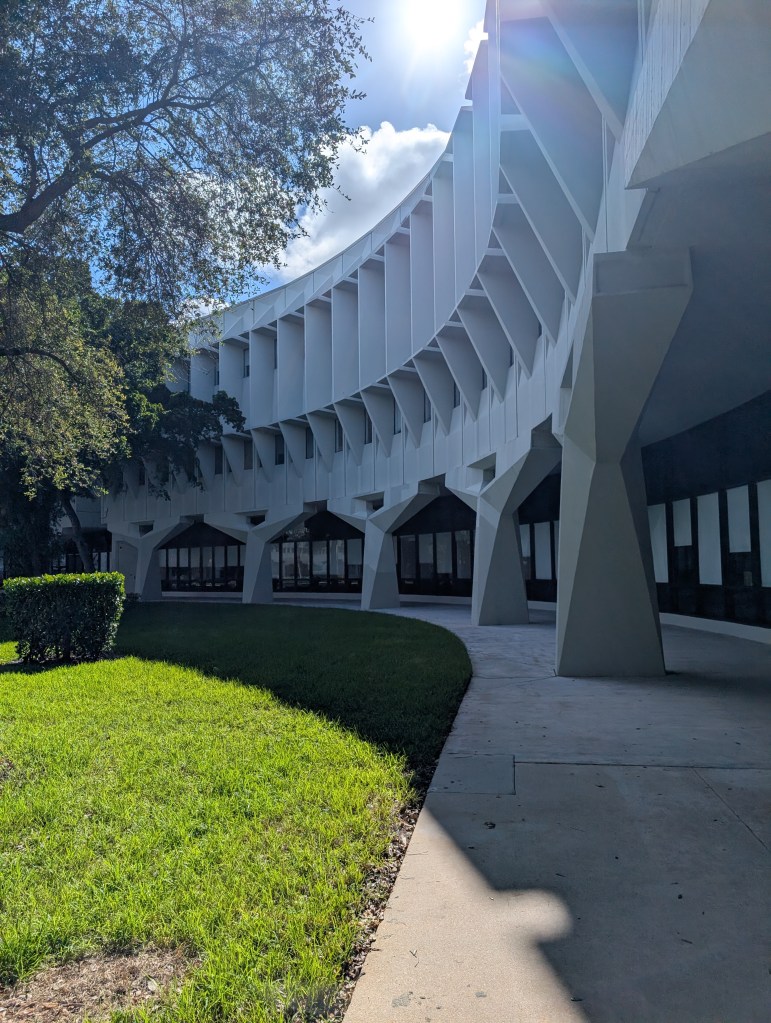
The building in the photograph above was co-designed by Marcel Breuer, master of Brutalist architecture. Here he used a series of columns, like concrete trees, to support the upper floors of his building. This building is part of the Boca Raton Innovation Campus (BRiC) in Boca Raton, Florida. It once belonged to IBM.
I have walked on the path along these tree-columns a hundred times. I am alarmed when it happens that I have walked along these tree-columns bodily, without being amongst them in spirit. In my walk I would fain forget all of my everyday occupations and obligations to society. But it sometimes happens that I cannot easily shake off my everyday life. The thought of some work will run in my head, and I am not where my body is, – I am out of my senses. In my walks, I would fain return to my senses. What business have to walk alongside these amazing tree-columns if I am thinking of something other than the tree-columns and Breuer’s wonderful brutalist architecture.
The writer and philosopher Henry David Thoreau, whom I have quoted and paraphrased in the paragraph above, wrote: “I have met with but one or two persons in the course of my life who understood the art of Walking, that is, of taking walks, -who had a genius, so to speak, for sauntering” (his essay, “Walking”).
Thoreau took his walks through the wild nature very seriously and I, in my walks along Breuer’s architecture, have tried my best to be perceptive and present, like Thoreau on his walks. But unlike Thoreau, I sadly have not learned the art of walking.
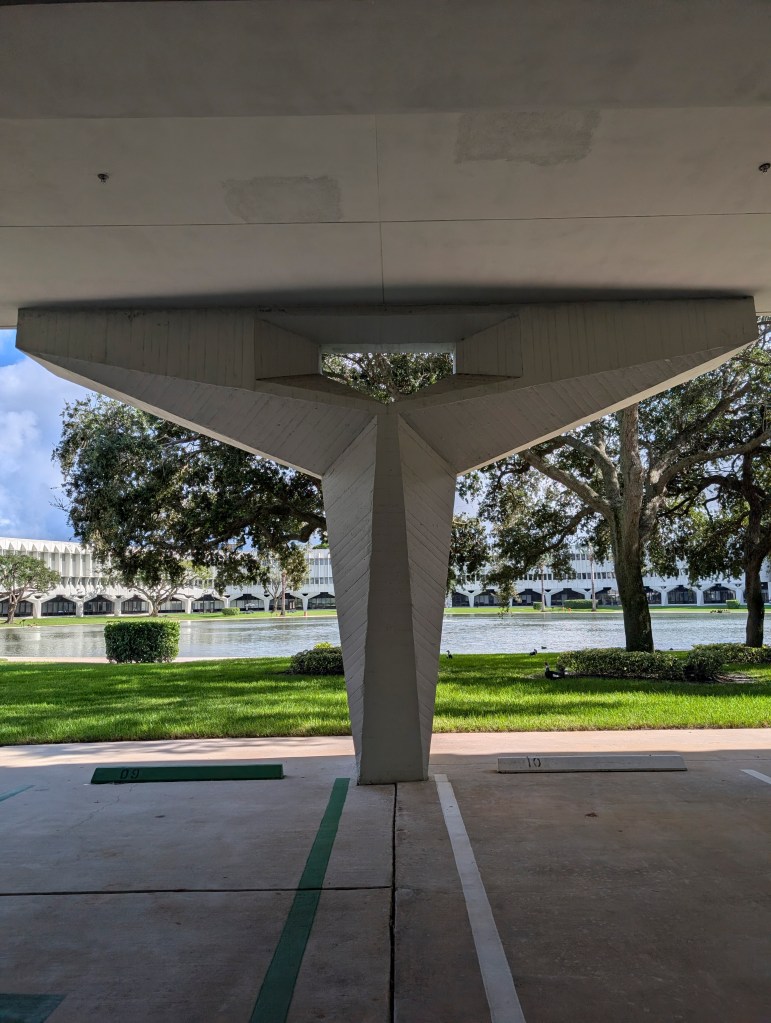
The concrete tree-column, photographed above, was co-designed by Breuer and is part of one of his Brutalist buildings in Boca Raton.
Thoreau wrote that a fruit-bearing tree “has its appropriate produce, and appointed season, during the continuance of which it is fresh and blooming, and during their absence dry and withered” (Walden). But he points out that a cypress, which bears no fruit, is never dry and withered and is instead “always flourishing.” Thoreau adds that to be truly free, human beings should seek to be like a cypress – always flourishing, no matter their circumstances.
This tree column, supporting Breuer’s building, is like a cypress in that it bears no fruit. But since the tree-column is merely concrete, and is not alive, could it be said to be flourishing? No matter. The concrete tree-column is strong and withstands the storms. It spites the wind. Even if it doesn’t flourish, it serves its purpose – both faithfully holding up building and adding to its beauty.
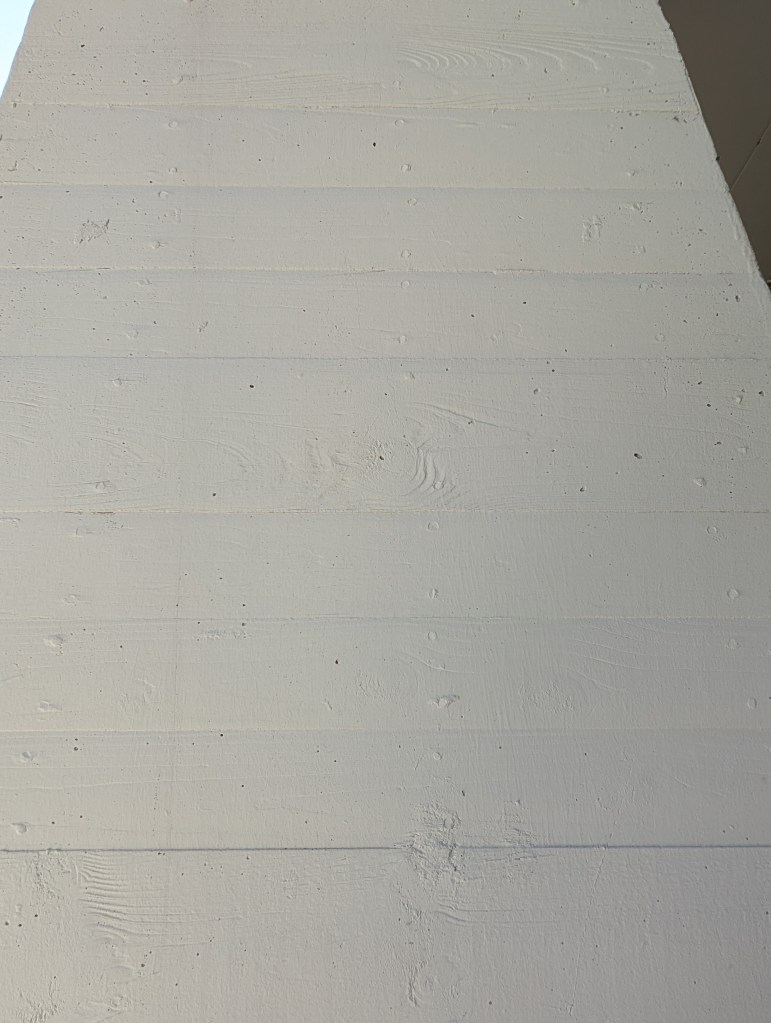
Breuer arranged for the tree-columns of his Brutalist buildings to be constructed out of board-marked concrete – concrete which takes on the appearance of the wooden formwork or mold used when the concrete was cast.
This photo shows one of the tree-columns close-up. It has been painted white, now, but you can still see some of the natural markings of the wooden formwork or mold used to create the column.
The tree-columns is made of concrete. But it nonetheless, in an abstract way, looks like a tree. It is textured and marked like wood. Like a real tree, the tree-column almost seems to have bark.
Henry David Thoreau, writer and philosopher, remarked: “I could study a single piece of bark for hours” (his Journal). Throughout his journals, he frequently describes the bark of a tree. Looking at one tree, he writes that its bark is “fringed and tasseled.” Looking at another, he says that the “yellow bark shines” (Journal). He claims that the “bark” from “before the sap flows in May” is “harder . . . than summer bark.”
Instead of a smooth, flat white surface, each tree-column at the Boca Raton Innovation Campus has the complex texture and marking of wood, which invites deeper reflection and focus than smooth concrete might be on its own. Their wood-textured surfaces also help to transform concrete tree-columns into abstract trees.
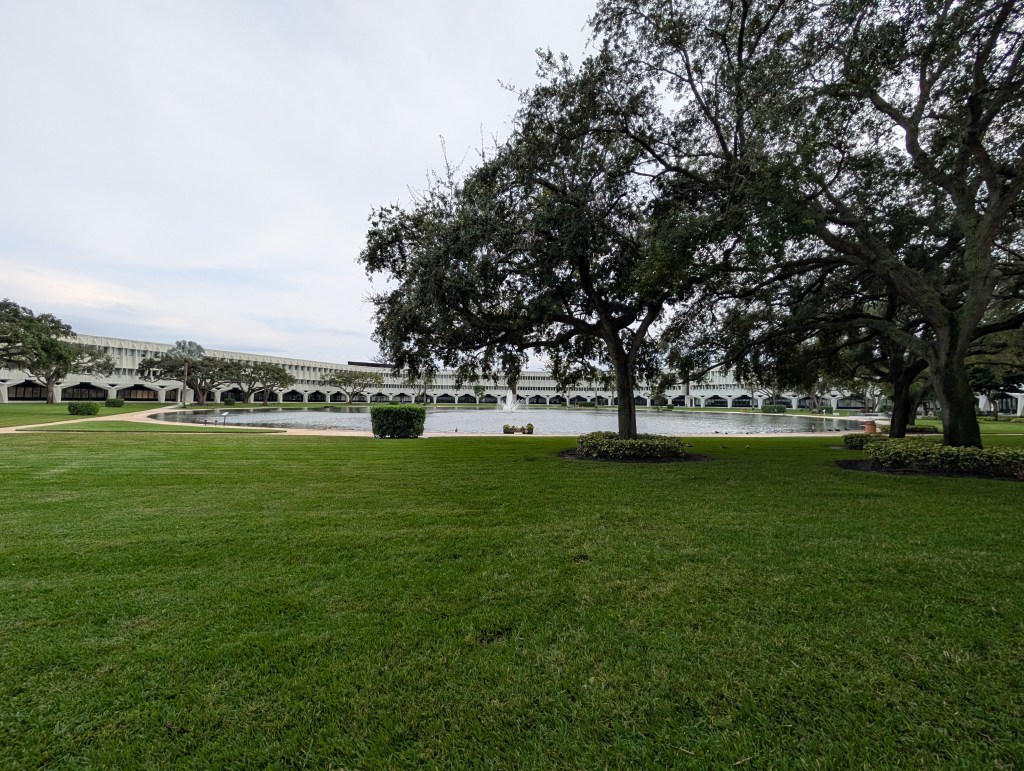
This is a photo of buildings co-designed by Marcel Breuer in Florida. Taken from a distance, the photo shows the long buildings curving around a pond. The concrete buildings are supported by Breuer’s identical tree-columns, and identical concrete sunshades project out around each of the building’s windows.
There is something impressive about these long buildings, seen from a distance like this, especially because of the repetitive patterns of the buildings’ façade – the repeating identical windows and tree-columns all taken together. The buildings are heavy, concrete, and cover massive land. Viewed from a distance, they compose a single work of art that offers a big-picture perspective.
This photo was taken on a weekend, and I saw no one near the buildings. I particularly enjoy walking on the path leading along these buildings over the weekend.
The writer and philosopher Henry David Thoreau wrote: “Ah! I need solitude.” And, needing solitude, he walked to the top of a hill to view the mountains in the distance. “I have come forth to this hill at sunset to see the forms of the mountains in the horizon, – to behold and commune with something grander than man” (his Journal).
Walking near Marcel Breuer’s buildings over the weekend, when there are no people, provides a moment of solitude and reflection. But it does not involve communing with something grander than man. Instead, visiting these buildings involves viewing and appreciating something man-made – something grand that man made – something artistic and impressive in scope that is also decidedly human. Still, looking at the buildings from a distance still offers a sense of a big-picture perspective very different from Thoreau’s but nonetheless valuable regardless.
While Thoreau would rather walk through a dismal swamp than “dwell in the neighborhood of the most beautiful garden that ever human art contrived” (Walking), I see value in the art of humans, in addition to Thoreau’s beauty of nature. There is value to walking on a path past tree-columns in addition to the value of walking on a path through a forest of trees.
-Andrew J. Corsa

