
*******
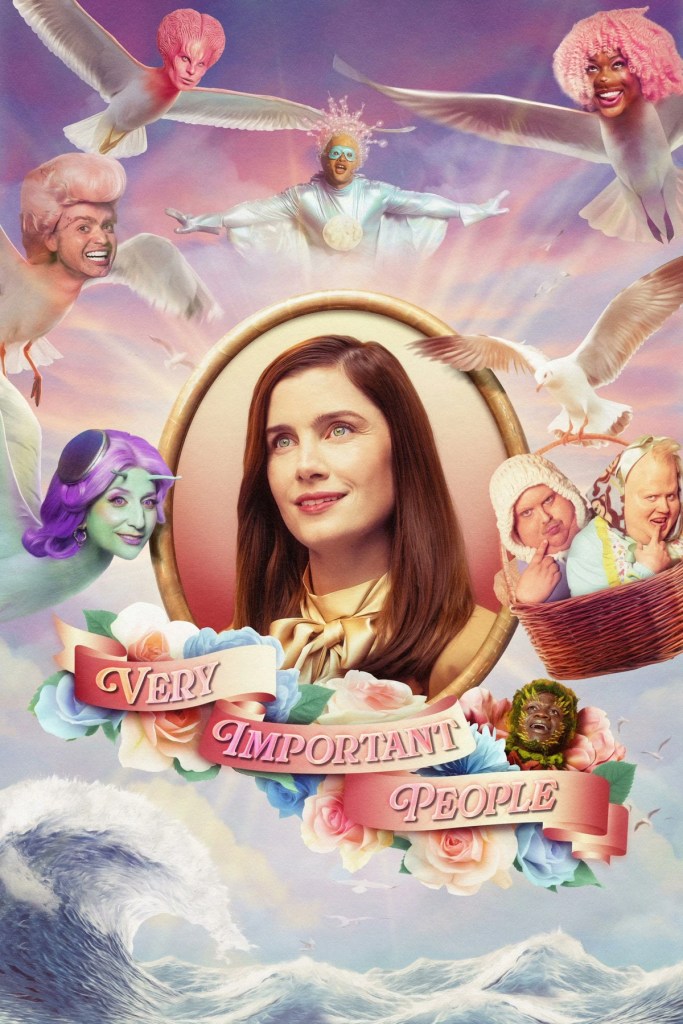
In this post, I will consider the Dropout TV show Very Important People in relation to several reflections by philosopher Sherri Irvin in her book Immaterial: Rules in Contemporary Art.
In her book, Irvin contends that some artworks are constituted by rules (2022, e.g. pp. 9, 28 & 115). Irvin writes that “the rules themselves have become part of the medium that artists are working in” (ibid., p. 6). Below, I will consider what this means by reflecting at length on a specific artwork by Jan Dibbets. After doing so, I will consider the possibility that the show “Very important People” might also be an artwork that is constituted by a specific set of rules.

Jan Dibbets – Artwork as Rules
To consider what it means for an artwork to be constituted by rules, let’s consider an artwork developed by Jan Dibbets in 1969 titled: All shadows that occurred to me in . . . . . . . . . . . . are marked with tape.
For this artwork, a team of artists enters a gallery space in a museum and observes the sunlight entering the space through its windows and doors. They see sunlight, surrounded by shadow, on the space’s floor and walls. Then the team uses tape to mark the boundaries of that sunlight, putting pieces of tape on the walls and floor to mark the edges of the sunlight. After they finish doing this, they wait for a while, as the sun’s position in the sky changes and the sunlight moves in the room. Then they mark the sunlight with tape again. They finish, wait for a while, and then repeat. The artwork is the result of the team’s work by the end of the day.
Dibbets intended for this same artwork to be displayed in numerous different museums, in numerous different museum spaces. At each new museum, a team follows the same procedure, using tape. Thus, since each gallery space is different and has different sunlight, the artwork looks very different in different museums. The same artwork has very different, variable displays (cf. Irvin, 2022, Chapter 2).
Dibbets also wants it to be possible for authorized museums to create displays of this artwork without him being directly involved. That is, it should be possible for a museum to create a display of this artwork without Dibbets visiting the gallery, laying down tape himself, or working closely with the team that lays down the tape.
Dibbets worked with the conservator and scholar Sanneke Stigter to develop a set of rules that a team of artists would need to follow in order to create an authentic display of Dibbets’s artwork at an authorized museum (cf. Irvin, 2022, pp. 109-117). What conditions would need to be met in order for visitors to a museum to enter a gallery space and truthfully say, “This is an authentic display of Dibbets’s work”?
Sherri Irvin maintains that Dibbets’ artwork just IS this set of rules for its creation and display (2022, p. 115). The artwork just IS this group of rules. It is an artwork constituted by rules.
This makes sense. After all, the artwork is not identical to the tape. Different tape is used in multiple different museums, and yet each of the museums displays the same artwork developed by Dibbets. Likewise, the artwork is not identical to a particular pattern of tape. After all, the patterns of tape in different museums is very different, and yet the museums all display the same artwork developed by Dibbets. And finally, the artwork is not some activity by Dibbets, himself. After all, Dibbets does not need to be involved for a gallery to create a display of the artwork. So what is Dibbets’s artwork? It is a set of rules.
Very Important People – Artwork as Rules
Now I would like to consider the possibility that the Dropout TV show “Very Important People” might also be an artwork constituted by a specific set of rules.
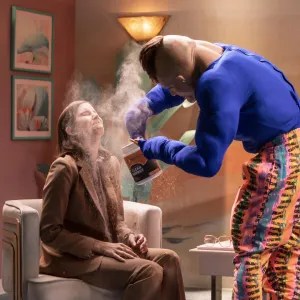
First, let me briefly describe the show Very Important People. In 2023, Dropout TV premiered its video-recorded show Very Important People on its streaming platform. Each episode features a guest performer (or two) who is trained at comedic improvisation. Make-up artists apply make-up to this performer, making sure that the performer has no idea what the make-up looks like. The performer is unable to see what they look like in the make-up, and the make-up artists do not tell the performer. The performer is also given a costume at the last possible moment, and the costuming team does their best to conceal what the costume looks like. Finally, the performer sees their reflection in a mirror. It is a big reveal! The performer is then given roughly ten minutes to brainstorm, quickly, what kind of character they want to create, based on the make-up and costume they now see. After that, the performer is brought onto a set with another performer – Vic Michaelis. In Very Important People, Michaelis plays the character of an over-the-top television interviewer – someone who interviews others on camera. Vic Michaelis then interviews the guest performer, who performs as the character they just quickly developed. Michaelis and the guest performer completely improvise the interview, without a script. This interview is recorded. It is the show Very Important People.
It strikes me that each episode follows a very specific set of rules. RULE 1: Bring in a guest performer (or two) who is trained in comedic improvisation. RULE 2: Put the guest performer in make-up and a costume, trying not to let the guest performer know what it looks like. RULE 3: Show the guest performer what they look like in a mirror. Give the guest performer some time (roughly 10 minutes) to brainstorm the character. RULE 4: Bring the guest performer on set and have Vic Michaelis interview the guest performer who plays their new character. The interview is improvised without a script. There might be other rules besides these, too.
I wonder if Very Important People is constituted by these rules. Would any specific performance, in the future, that follows these rules and is authorized by Dropout count as an instance of “Very Important People”?
Suppose Vic Michaelis and a guest performer performed live, unrecorded, following these rules, and were authorized to do so by Dropout. Would that count as an instance of “Very Important People”? If so, then it seems like the rules matter more than the recording does. Relatedly, suppose – after numerous additional seasons of the show – Dropout decides not to create or air additional episodes for its streaming platform. But now suppose that, after twenty years, Vic Michaelis and a guest performer perform live, unrecorded, following these rules, and were authorized to do so by Dropout. Would this count as an instance of Very Important People? If so, then it seems like something could be an instance of Very Important People without belonging to a recorded season on Dropout. Perhaps Very Important People is, at its heart, a set of clever rules, similar to a game.
FINISHED

