*******
Baruch Spinoza, the 17th-century philosopher, liked to draw. He created portraits – sketches – of prominent people he met using ink and charcoal. One of Spinoza’s early biographers – Colerus – maintained that Spinoza had also sketched a self-portrait (Stewart, p. 97).
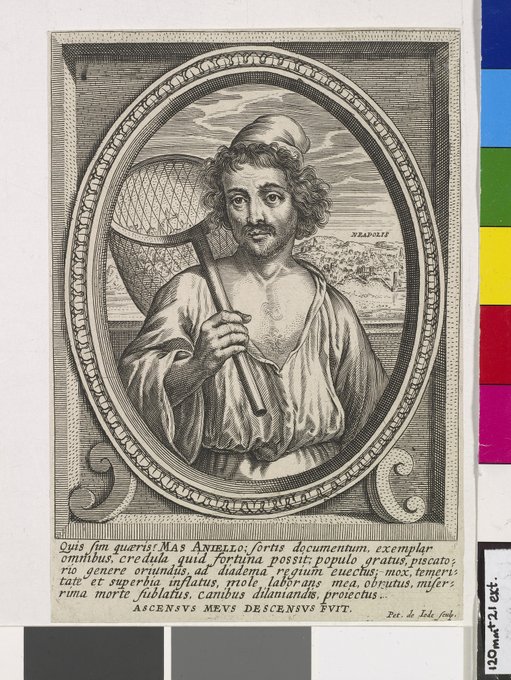
Apparently, Spinoza had based his self-portrait on images of the Italian revolutionary Tommaso Aniello, also called “Masaniello” (Stewart, 2006, p. 97). Masaniello was a fisherman who led a short-lived 1647 revolt against the rule of Spain before he was murdered and torn apart. Many portraits of Masaniello portrayed him as a common fisherman, with a fishing net on his shoulder. One such portrait of Masaniello, by Pieter de Jode, appears below.
According to Colerus, Spinoza had – in his self-portrait – made himself look much like Masaniello. Spinoza had portrayed himself in a similar pose, looking like a fisherman with a net (cf. Stewart, 2006, p. 97).
It appears that Spinoza saw himself as somehow LIKE Masaniello. Did Spinoza see himself as a “hero of the people” (Stewart, 2006, chapter 6)? Did Spinoza see himself as seeking liberation? Did he view himself as doomed to potentially meeting a tragic fate like Masaniello?
Spinoza’s self-portrait is lost to time, but portraits of Masaniello, like that included below, still exist and give at least a rough sense of how Spinoza’s self-portrait might have looked.
[Above I cited Matthew Stewart’s 2006 book, “The Courtier and the Heretic.”]