*******
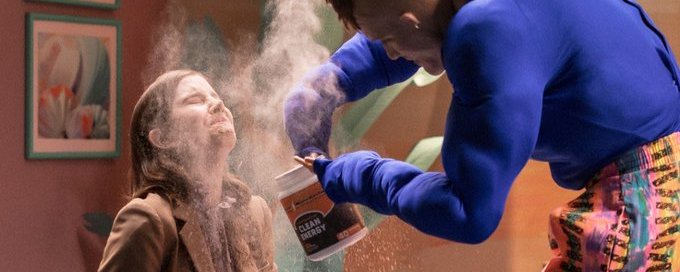
This particular blog post focuses on the Dropout TV show Very Important People. That said, I would love to write a BOOK about Dropout TV overall, quoting from interviews with its performers and productions staff. To get a book like this written and published, I would need a little help from Dropout TV. If anyone who reads this can get me in touch with people at Dropout who can help, please leave a comment!
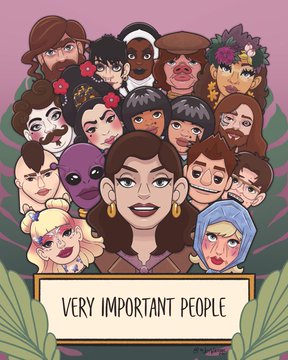
How was the Dropout TV show Very Important People made? How did its performers work together with its director, co-executive producers and makeup artists to create it? Why do the performances in Very Important People have a sense of immediacy and spontaneity? How does the show give performers the opportunity to display their authentic creativity, imagination and wit? And how can Very Important People also – at the exact same time – tell good stories, each with a clear beginning, middle and end?
To answer these questions, this article will quote from interviews with the show’s performers, its makeup department head, several of its co-executive producers, and its editor. This article will also reflect on what professional philosophers have written about improvisation and its aesthetic qualities.
This article will quote from interviews with many of the show’s performers and production staff. The interviews were conducted by Jordon Brown, and he gave me permission to quote from them.
Introduction to Very Important People
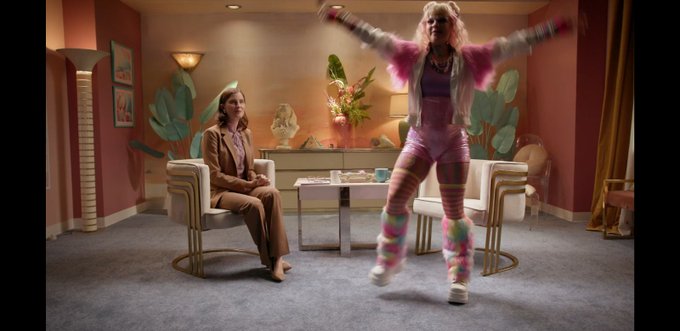
Every episode begins with a performer introducing themselves. For example, performer Ally Beardsley appears on screen in a white robe and says: “Hey. I’m Ally Beardsley. I’m here on Very Important People. I think it’s taking me a second to wrap my mind around what I said ‘yes’ to.”
After the performer introduces themselves, we see the performer – Beardsley – in a makeup chair, having makeup applied. The makeup artists make sure Beardsley has no idea what the makeup looks like. The audience hears Vic Michaelis’s voice, in a voice-over.
Michaelis says: “Today we’re giving this comedian a total transformation. They have no idea who or what they’re about to become. Once they see themselves in the mirror they’ll have to make up a character, on the spot and then sit down with me for an improvised interview. This is Very Important People.”
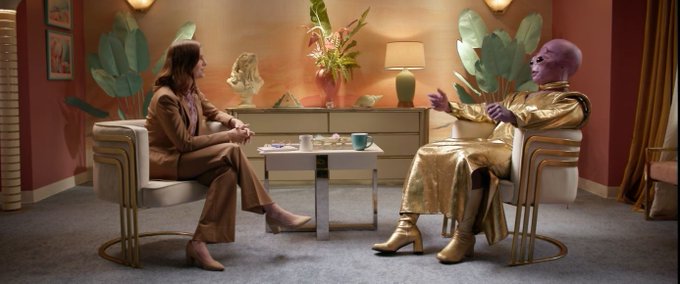
The performer, who has no sense of what they look like, approaches a mirror and sees their makeup and costume for the first time. It’s a big reveal. Then the performer develops a character, based on the makeup and costume, and sits down with Vic Michaelis, who plays a professional television interviewer. The performer is interviewed in character.
Behind the Scenes: Performers and Makeup
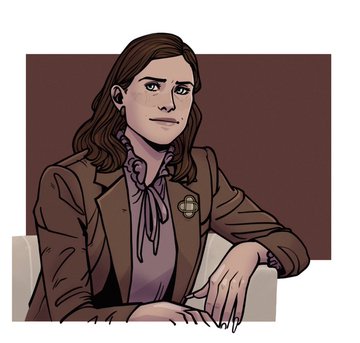
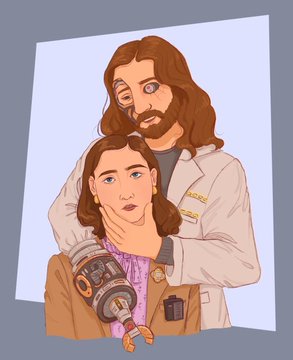
Brian David Gilbert performs with Vic Michaelis in a different episode of Very Important People. He plays a character called “Avery Goodman” who has robotic implants and a hook for a hand.
In an interview with Jordon Brown, Brian David Gilbert says that friends have asked him how much time he had to prepare his character before he performed. He says: “You get maybe 10 minutes as they’re prepping the cameras.” He adds that he did not speak with Vic Michaelis for long before the filmed performance began: “The first time I ever met Vic was on set in full makeup. I had never met Vic beforehand.”
The makeup department head and key makeup artist – Alex Perrone and Ana Gabriela Quinonez Urrego – work together. While they apply makeup, they make sure that performers cannot figure out how their characters look. How can they prevent performers from figuring it out? How can they fool the performers? In an interview with Jordon Brown, Perrone says that she had a conversation with the show’s director about how to interact with guest performers: “I was like, ‘Do I have permission to lie to these people?’ And she was like, ‘You have permission.’”
The makeup team puts on a performance, having fake conversations about characters and using code-words for different pieces of makeup. In her interview with Jordon Brown, Perrone talks about the makeup team’s fake conversations. Perrone says: “We would pretend to step out of the room. It’s only a curtain dividing. And we would whisper loudly different things like we thought we were in secret, and then I think they were falling for it, because we’d come in and I’d be like, ‘You didn’t hear anything, did you?’ And they’d be like, ‘No, no, no, no.’ And I knew they did. So I’m hoping that throws them off enough.”
After the performer sees their character in a mirror, the performer has about ten minutes to brainstorm before being brought on set. When brought on set, the performer speaks with Vic Michaelis, the interviewer, for just a moment before the filmed performance starts.
Vic Michaelis, who plays an over-the-top interviewer, says that they have no idea, before shooting starts, what kind of character the guest performer is going to play. In a first interview with Jordon Brown, Michaelis says: “I don’t know what character is coming out. I have no idea who these people are choosing to be.” Michaelis says that they have a rough sense, in advance, of what the performer’s makeup will look like. Michaelis knows “the code name for the makeup.” But Michaelis has no idea what kind of character the performer will create based on that makeup.
Behind the Scenes: Filming in Chunks
For most of the episodes that were recorded, Vic Michaelis and the guest performer engage in genuine, unplanned improvisation for about ten minutes before the show’s director, Tamar Levine, calls “cut” for the first time. In her first interview with Jordon Brown, Levine explains this step of the process: “So we basically gave them about 10 minutes of just kind-of free-for-all, just kind-of-like workshopping, and the workshopping was the interview – it really was – but after about 10 minutes I would think, ‘Okay.’ So that is when I would cut, at about ten minutes.”
Then the co-executive producers, director, and performers have a very short conversation, discussing how the rest of the performance might go. Levine says: “We were all able to workshop in a very, very, very short amount of time. Like we had 30 seconds, you know, when I called ‘cut.”” Later Levine adds: “Vic would pitch things and the guests would pitch things and it was really just kind of like magic. Really like it was just a perfect way to do it.”
Often, in live improvisatory performances, actors ask for prompts and recommendations from a live audience. In Very Important People, the performers instead take prompts and recommendations from a director and co-executive producers. But the performers still need to make up all of their characters’ individual sentences and responses, themselves. After the first cut, the director typically keeps filming the performers’ improvisation in roughly 15-minute chunks, with only short breaks in between.
Improvisation and Philosophy
When audiences watch Very Important People, they know they are watching performers improvise. Audiences know that while the show was filmed, the performers came up with the sentences they spoke on the spot, right before speaking. As a result, the performances in Very Important People have a sense of spontaneity and immediacy (cf. Bresnahan, 2015, p. 579).
Everything that Michaelis says during each performance is unexpected to the guest performer. And everything the guest performer says is unexpected to Michaelis. The performers never know what exactly is coming next! As the philosopher Georg W. Bertram writes, “The unexpected is an essential element of improvisation” (2022, p. 23).
Imagine a fielder in a game of baseball. He knows that it is likely that, during the game, he is going to catch a ball. Now he is in the middle of a game and he sees a ball flying overhead. He could never have predicted in advance that a ball would fly out to this-specific-place, with this-specific-speed, at this-specific-time. It is completely unexpected (Ryle, 1976, p. 73).
Now imagine Brennan Lee Mulligan improvising as a guest performer with Vic Michaelis in an episode of Very Important People. He knows that Michaelis will ask his character questions, but he could never have predicted in advance exactly what questions he will be asked. Brennan Lee Mulligan is a trained improviser. He knows how to respond to the unexpected (cf. Bertinetto & Bertram, 2020, p. 205). He has developed skills and habits that help him respond to the unpredictable – to be prepared for never being completely prepared (Bertinetto & Bertram, 2020, pp. 205 & 213). It is joyful, watching Brennan Lee Mulligan demonstrate his skill at improvisation, responding to Vic Michaelis with imagination, quick cleverness, and wit (cf. Cannone, 2022).
Suppose, for a moment, that you are watching a stereotypical scripted film, the screenplay of which was written long before it was filmed. If the author of the screenplay took a year to write it, the screenplay might not authentically express that writer’s inner self or the writer’s true thoughts and feelings. The author had the time to think and to self-censor before writing, and the author could repeatedly revise the screenplay. By the time the screenplay is performed, it might have been revised enough that it gives no sense of the author’s authentic self (cf. Sterritt, 2000, pp. 163 & 166-167). Now imagine actors are performing, based on that screenplay, on camera. By this point, the words the actors speak are not new to them; they have already read the screenplay and are speaking words they have memorized. The actors can certainly engage in creative interpretation of the screenplay, but they cannot engage in the same kind of invention as improvising performers (Sterritt, 2000, p. 163).
When Brennan Lee Mulligan performed in “Very Important People,” he invented every single sentence he spoke – making it up on the spot in response to what Vic Michaelis had said. Improvisers like him give their audiences a sense of their “unique souls” – their authentic selves and their true creativity (cf. Sterritt, 2000, p. 163). Improvising performers have very little time to self-censor and they have no chance to revise what they have said (Brown, 2000, p. 114). Audiences see these performers’ raw, unedited, and unfiltered creativity. We know that improvising performers make it up on the spot. When we watch an episode of “Very Important People,” and its words are brand new to us, we know that every sentence the performers speak was brand new to the performers when they were being filmed. As the philosopher Aili Bresnahan writes: “Much of what happens in an improvisational performance is new and immediate to the artist as well as to the audience” (2015, p. 579).
Thus, even when audiences are watching a recording of an improvisation, the performance nonetheless has a wonderful sense of immediacy and spontaneity. Dropout TV captures and preserves spontaneity on camera when it shoots Very Important People.

Zac Oyama
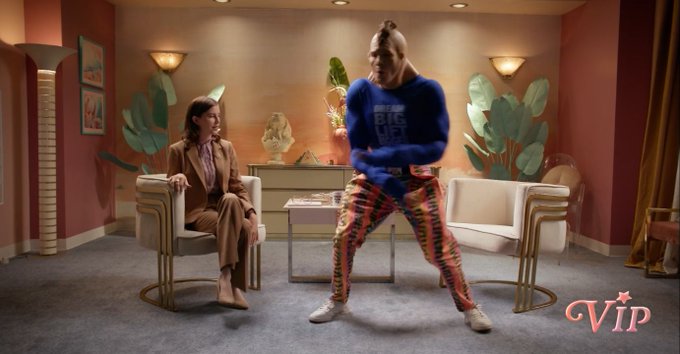
Jordon Brown interviews a co-executive producer of Very Important People, Kyle Rohrbach, who is also the head of production at Dropout. During the interview, they speak about Zac Oyama’s work as a guest performer on Very Important People.
Brown notes that, by the time Zac Oyama performed in Very Important People, Oyama had already performed in many other Dropout shows. Brown describes the way that audiences typically see Oyama: “For us we see him a lot like that joke sniper – just waiting for the right moment and pouncing on it.”
Brown notes that, when Zac Oyama performs in Very Important People, he does not act like a joke sniper. Instead, he plays the “over-the-top personality” that is the character Tommy Shrigley. Brown says that Oyama’s performance was particularly fun because: “I get to see them sort-of-like in a different element than what we normally do.”
In response, Kyle Rohrbach says: “A lot of times someone like Zach who is a brilliant comedian is surrounded by a lot of other brilliant comedians and . . . he is more of that – you know – dry delivery, sniper-type . . . Whereas on a show like Very Important People, he stands alone. It’s him on the stage with Vic . . . That’s an opportunity to exercise parts of you you don’t always get to exercise.”
When Zac Oyama improvised with Vic Michaelis in Very Important People, we, in the audience, became better able to appreciate Zac Oyama as a performer. The performance revealed to us another side of Oyama’s authentic humor, creativity, spontaneity, and invention. Because it was an improvised performance, Zac Oyama was able to reveal to us – not the creativity of a screenwriter – but rather a different aspect of his own, unique creativity.
Philosophy, Improvisation, and Process-as-Product
Imagine you are watching a stereotypical scripted film. As you do, you cannot see the person who came up with the film’s words or story. The screenwriter is not on camera. The screenwriter and her creative process are invisible to you as you watch (Sawyer, 2000, pp. 149-150).
Now imagine you are watching an episode of Very Important People. You see in front of you performers who come up with every word you hear. You watch the performers as they think on their feet, making up the show as they go along. You are watching, not just a performance, but also the creative process that created the performance (Sawyer, 2000, p. 149). You watch the performers think, create, and act all at the same time.
Consider the episode of Very Important People in which Ify Nwadiwe is the guest performer. At one point, Nwadiwe’s character mistakenly implies that the light from the moon does not come from the sun, and Michaelis’s character corrects him. In response, Nwadiwe pauses for a moment before he replies. During that pause, we see Nwadiwe, the performer, think on his feet about how to respond. As Clément Canonne writes, “To attend an improvisatory event is also to apprehend a real-time thinking process” (2022, p. 539).
In Nwadiwe’s first interview with Jordon Brown, he describes this specific moment during his performance in Very Important People. He says that, in this moment, he could have taken the episode in two very different directions. Nwadiwe says that he had two major options. He could – hypothetically – have said, “Oh, y’all humans still think that’s how the moon lights up!” If he had said this, then the rest of the episode would have been about “alien secrets.” But instead, Nwadiwe chose to take the scene in a different direction. He chose to make his character uninformed – not scientifically literate – and the episode was even funnier as a result.
We – the audience – see Nwadiwe make this choice right in front of our eyes. We watch him and Michaelis in the middle of their creative process, thinking on the spot and creating the show. Nwadiwe and Michaelis are like jazz performers, simultaneously both composing and performing in front of us (cf. Alerpson, 1984, pp. 19-21). The philosopher Philip Alperson writes: “It is as if the improviser’s audience gains privileged access to the composer’s mind at the moment of musical creation” (1984, p. 24). When we watch Michaelis and Nwadiwe perform, it’s almost as if we can look into them and see their creative process.
In Front of the Mirror
Very Important People shows its audience the moment when its guest performers look into a mirror and see their makeup and costume for the first time. The show also lets audiences see the performers as they brainstorm, in front of the mirror, about what their characters will be like.
We see the performers come up with a wide variety of different characters, testing out different accents and voices, to see what might work best. We see the performers demonstrate their skills in divergent thinking – “the ability to come up with multiple responses to a single prompt” (Goldstein, 2024, p. 106). In “Very Important People,” we can see the guest improvisers come up with many wonderful characters in response to their makeup and costume.
As the psychology professor Thalia R. Goldstein notes, psychological studies indicate that classes in improvisational theatre help their students develop better skills at divergent thinking (2024, p. 106; cf. Hainselin et al., 2018). More broadly, Goldstein argues that theater classes teach students skills, behaviors, tendencies, and strategies that help them become more flexible, come up with new ideas, and adapt to changing circumstances (2024, pp. 104-105; cf. pp. 6 & 39).
In Isabella Roland’s improvisatory performance in Very Important People, she demonstrates great skills in divergent thinking and flexibility. After seeing her dress and makeup, Roland quickly comes up with a dozen different possible characters. Looking in the mirror at her costume, she says: “Well, the gown is the most beautiful thing I’ve ever seen in my entire life.” Then she says: “Mermaid got lost at the ‘Jersey Shore.’” Then she says: “New Orleans Psychic who is a manager at Waffle House.” Then she says: “But I also just sort of feel like I own a nail salon or a travel agency.”
In an interview with Jordon Brown, Isabella Roland says she was pregnant during her performance, “and everyone was so careful with me and everyone was being so kind and conscientious and compassionate and then it was like – well – this is the heaviest dress I’ve ever worn. It is beautiful and it was worth it, and I would do it again, and a humongous wig.”
Later in the interview, Roland explains what was going through her mind when she first saw the costume and makeup: “There was a moment where I was like, ‘Oh, okay, I get where they’re going with this.’” Roland says that, standing in front of the mirror before the performance, “I started doing a Long Island Jersey accent.” But then she realized that a large percentage of Dropout TV’s audience had already seen her perform a similar character, with a similar accent, in a different show. So Roland decided to do something different, and created, instead, a character from Texas who had moved to Florida. Roland demonstrated great flexibility, developing a new character for the performance instead of creating a character similar to those she had performed before.
Hainselin et al. (2018) note that teenage students who had taken a course in improvisation demonstrated greater skills in divergent thinking than students who had not studied improvisation. The researchers also found that, when presented with a prompt, those who had taken an improvisation course gave a smaller percentage of “prototypical” responses (2018, p. 4). What does this mean? The students were given three minutes to name possible uses for common items, like a paperclip and a remote control (2018, p. 3). Students who took the improvisation course were less likely to name a large number of obvious uses, like “holding paper together” for the paperclip or “changing channels” for the remote. Instead, the students who studied improvisation tended to think outside the box.
All of the performers in Very Important People thought outside the box like this, creating unexpected, fun characters based on their makeup and costumes. A great example of this comes from the episode featuring Oscar Montoya and Jiavani Linayao. In their episode, these two performers looked nearly identical, with the same outfits, haircut, and makeup. But, instead of choosing to play twins, the two performers chose to perform as a married couple! What a divergent idea!

Behind the Scenes: Story and Editing
The director of Very Important People, Tamar Levine, works together with the show’s co-executive producers, performers, and editor to make sure that each episode includes a good story with a clear beginning, middle, and end.
In her first interview with Jordon Brown, Levine talks about the questions she asked herself while shooting each episode: “How can we come up with a beginning, middle, and end, and how does Vic’s point of view change on this person as well, or this character?”
When filming starts, Levine has no idea what character the guest performer has created or how that character might interact with Michaelis’s character. For the first ten minutes that the performers improvise on camera, Levine pays close attention and communicates with a team that works behind the scenes, trying to figure out what the episode’s story could be like overall.
When Levine calls “cut,” she talks with the performers very briefly about what the rest of the episode might be like, what it might include, and how its story might be structured. Michaelis, the guest performer, the co-executive producers, and others all bounce ideas off each other.
In her first interview with Jordon Brown, Levine talks about the importance of having a clear story in each episode: “You need some sort of story, just something to ground you and be like, ‘Okay, this is Vic’s point of view in the beginning. This is Vic’s point of view at the end. This is the guest point of view in the beginning. This is the guest point of view at the end.”
Much of the story of each episode is also shaped by show’s editor, Eve Hinz, after the show is filmed. Levine says that at the end of each shoot, the team has “about three and a half hours of footage total that we have to shape into a tight 15-30 minutes, so editing is very important and Eve is killing it. She’s incredible.”
Hinz chooses what to include in each episode, and she also rearranges different parts of the footage. Some of the content that audiences see early in an episode was actually shot later. Ultimately, each episode is designed to tell a story with clear beginning, middle and end – a clear arc. How does Hinz do it?
In her interview with Jordon Brown, Eve Hinz says: “Before I started editing, we had a phone call with all of us – Tamar, David, everyone . . . It was scheduled for 30 minutes and end up being two hours just going through every single episode and in that meeting they and Tamar went over the structure they came up with. This is what it will be. So whenever I would start a new episode I would refresh, look at what the intended arc is, and then go from there.”
Hinz creates a first-cut of the episode on her own, which she then shares with Levine. Hinz says that for most shows, the editor does not meet with the director in-person to talk about the editor’s cut for each episode. But for “Very Important People,” Levine and Hinz meet in-person.
Hinz says: “We decided, ‘Hey, let’s meet in-person and just do it together.’ And so for each episode we’d have one session right after my editor’s cut where we’d sit down together for a couple hours and go through it, and truly – so much fun – and it made it so nice because were were able to connect in those ways and then established this working relationship where it’s like so informal, where we’re just, like, texting each other.”
David Kerns’ Dog
During filming, Dropout TV sometimes films three episodes of Very Important People each day. This means that it can only spend a few hours filming each episode. Levine says: “It’s not like we had eight hours to kind of let them see what was going to happen and then, you know, just figure it out.”
As a result, the show’s director and co-executive producers need to think and act quickly. They need to improvise right along with the performers. They watch the performers improvise and, based on the performers’ unexpected performances, quickly come up with ideas for how the rest of the episode could go.
Tamar Levine – the director – could have no idea what the story of each episode would be until she began to watch the performers improvise on camera. She needs to rapidly make up ideas for the story of the episode based on how the performers choose to improvise. Levine needs to quickly respond to the performers much like the performers need to quickly respond to each other. The director needs to improvise as much as the performers do! The philosopher David Collins writes that: “directing can be considered improvisatory when the director’s idea of the whole to which the parts will add up is open and evolves in response to what occurs during shooting” (2019, p. 269).
Paul Robalino is a co-executive producer for Very Important People. During his interview with Jordon Brown, he talks about thinking on his feet while working on set alongside Tamar Levine and David Kerns, who is one of the show’s executive producers. Robalino says: “We’re there laughing and enjoying ourselves but at the same time we’re . . . conversing between me, him, and Tamar, being like: ‘What should our next segment be? Or what are things that we can do now, seeing how the interview has taken course?’”
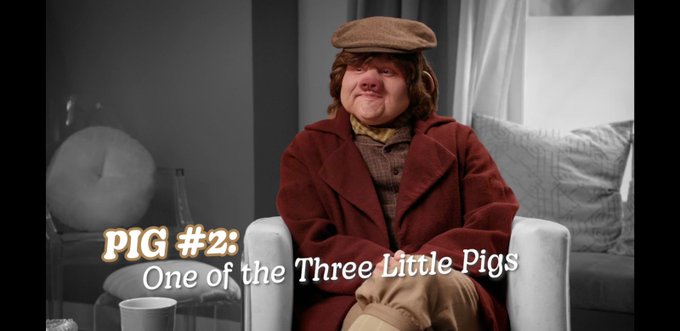
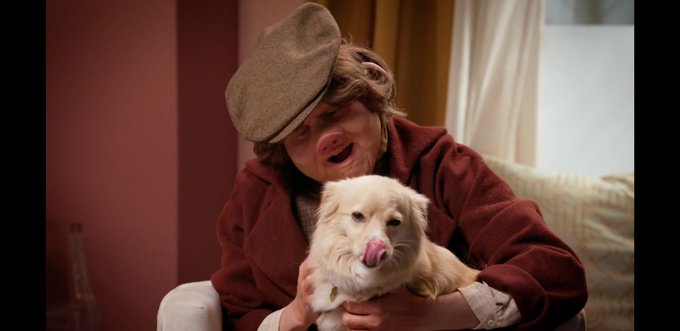
Robalino tells Jordon Brown a good story about working on the episode in which Ally Beardsley, as the guest performer, plays one of the three-little-pigs whose mother is killed by a dog. Robalino talks about working with the director and other producers. He says that, as producers: “We’re kind of like acting in real time and making quick decision in that way. One example being Ally as Pig Number Two. I think it was Tamar’s idea: ‘Oh, why don’t we show them pictures of dogs as, like, a sort of therapy?’ And so literally I pulled stock dog photos up on Shutterstock on my laptop and I was standing right there going one-by-one as they’re looking at the photos of the dogs.”
What happened next? Robalino continues the story. He says that the team backstage was talking together and they asked themselves: “What if we brought in a real dog? And then I said to David, ‘Hey, what about you go grab your dog? You live kind of close.’ And he’s like, “Oh my God, okay, should I? Should I? Should I?’ And so he, like, sped off, drove out, got his dog, came back in time for the end to surprise Ally with it.”
Robalino says: “The dog at the end . . . . was David Kerns’ dog.”
Conclusion: Start Creating!
During his interview with Jordon Brown, Ross Bryant describes many of the fans of Dropout TV. He says:
“Yeah, it does seem to be a ‘community,’ if I can call it that, of very warm-hearted, kind and supportive people who are very enthusiastic about what we make. And as somebody who makes things, what more could you ask for? That’s so wonderful – to be reaching people. And as somebody who tours around a fair amount doing shows on the road with improvised Shakespeare and other things, it’s now become such a frequent occurrence that after a show in Denver or New York or DC or Des Moines, someone will come up to me afterwards and say that they came because of Dropout. And that’s always – that always just blows my mind. And it’s so cool that it’s because you get that there’s this broad reach because as an improviser you’re so used to building a little world in front of an audience of 50 . . . It’s nice that we get to transmit this to so many people and have it resonate.”
Most comedic improvisers perform live for small audiences. Every improvisatory performance is unique, and typically only fifty people will ever see any given unique performance. Likewise, if the performance is not recorded, the audience can only see it once. But when Dropout records an improvisatory performance and shares it online, the performance has much greater reach.
Fans of Dropout TV can watch and re-watch an improvisatory performance numerous times, and then engage and interact with other fans from around the world who have also watched the same performance. They can engage in “Fannish practices,” such as making fan art and fan fiction, and participate in extensive discussions on Reddit and on social media platforms (cf. French, 2023, p. 211.)
Many of Dropout’s shows give audiences the chance to see performers being creative: making up stories, characters, songs, and jokes. “Very Important People” in particular gives performers an opportunity to display their authentic creativity, imagination and wit in performances that have a sense of immediacy and spontaneity while telling good stories. “Very Important People,” like so many Dropout shows, seems to invite its fans to respond to it with their own creative content, whatever that might happen to be! This essay, itself, is part of my own “fannish practice.” I wouldn’t have written it if I weren’t a huge fan. And I suspect that Jordon Brown’s interviews of the Dropout team are part of his own fannish practice.
So now, Reader, I guess it’s time for YOU to START CREATING!

Scholarly References
Alperson, P. (1984). On musical improvisation. The Journal of Aesthetics and Art Criticism, 43(1), 17-29. https://doi.org/10.2307/430189
Bertinetto, A. & Bertram, G.W. (2020). We make up the rules as we go along: Improvisation as an essential aspect of human practices? Open Philosophy 3, 202-221. https://doi.org/10.1515/opphil-2020-0012
Bertram, G.W. (2022). Improvisation as normative practice. In A. Bertinetto & M. Ruta (Eds.), The Routledge Handbook of Philosophy and Improvisation in the Arts (pp. 21-32). Routledge.
Bresnahan, A. (2015). Improvisation in the arts. Philosophy Compass, 10(9), 573-582. https://doi.org/10.1111/phc3.12251
Brown, L.B. (2000). ‘Feeling my way’: Jazz improvisation and its vicissitudes – A plea for imperfection. The Journal of Aesthetics and Art Criticism, 58(2), 113-123. https://doi.org/10.2307/432090
Cannone, C. (2022). Improv, stand-up, and comedy. In A. Bertinetto & M. Ruta (Eds.), The Routledge Handbook of Philosophy and Improvisation in the Arts (pp. 530-543). Routledge.
Collins, D. (2019). Aesthetic possibilities of cinematic improvisation. Croatian Journal of Philosophy, 19(56): 269-295. https://doi.org/10.5840/croatjphil201919218
French, E. (2023). “We play Dungeons and Dragons!” How actual play live streams have (re)shaped the D&D gaming community. In J. Brewer, B. Ruberg, A.L.L. Cullen & C.J. Persaud (Eds.), Real Life in Real Time: Live Streaming Culture (pp. 203-216). The MIT Press. https://mitpress.mit.edu/9780262545655/real-life-in-real-time
Goldstein, T. (2024). Why Theatre Education Matters: Understanding its Cognitive, Social, and Emotional benefits. Teachers College Press.
Hainselin, M., Aubry, A., & Bourdin, B. (2018). Improving teenagers’ divergent thinking with improvisational theater. Frontiers in Psychology, 9: 1-9. https://doi.org/10.3389/fpsyg.2018.01759
Ryle, G. (1976). Improvisation. Mind, 85(337): 69-83. https://doi.org/10.1093/mind/LXXXV.337.69
Sawyer, R.K. (2000). Improvisation and the creative process: Dewey, Collingwood, and the aesthetics of spontaneity. The Journal of Aesthetics and Art Criticism, 58(2): 149-161. https://doi.org/10.2307/432094
Sterritt, D. (2000). Revision, prevision, and the aura of improvisatory art. The Journal of Aesthetics and Art Criticism, 58(2): 149-161. https://doi.org/10.2307/432095


Leave a comment